Free To Play Annual Event
Three week limited time event themed around a midsummer festival to celebrate the heroic deeds of Destiny’s player characters
Centered around a quest involving powering up an ornate suit of event themed player armor, eventually allowing players to earn and imbue it with flashy elemental glows. Featured a bespoke activity, currency and economy, and item and cosmetic rewards
I worked with other members of the Events Team to design and implement the core event progression systems, balance the economy, upkeep and maintain the event, and lead the implementation of the event activity
Directly contributed to three annual iterations of this event
Lighting The Fires Of Progress
Solstice of Heroes was the new Events Team’s second shot at creating a massive update for an event, and we went big with this one. For our first new iteration of solstice in 2022, we introduced a massive systemic reworks to the very framework of destiny events that would go on to become the new systemic paradigm for all events going forward. This new systemic structure was known as the Event Card, and it essentially made events into miniature Destiny Seasons. The card functioned as the hub for the event, and had a special spot it occupied in the game’s quest menu. It had a suite of challenges players could complete over the event’s three week duration to earn a variety of rewards, including event weapons, cosmetic items, and currencies. The challenges also awarded tickets that could be redeemed to claim a special suite of premium event-themed cosmetics if players purchased an Event Pass for real money, which helped make events a revenue driver as well as an engagement driver. The challenges had objectives designed to encourage players to participate in the event and the wider game world, and were tuned to be easily completable within the three week time window. If a player completed all the challenges, they would unlock the event seal, which would give them a special event themed title to display to the rest of the community.
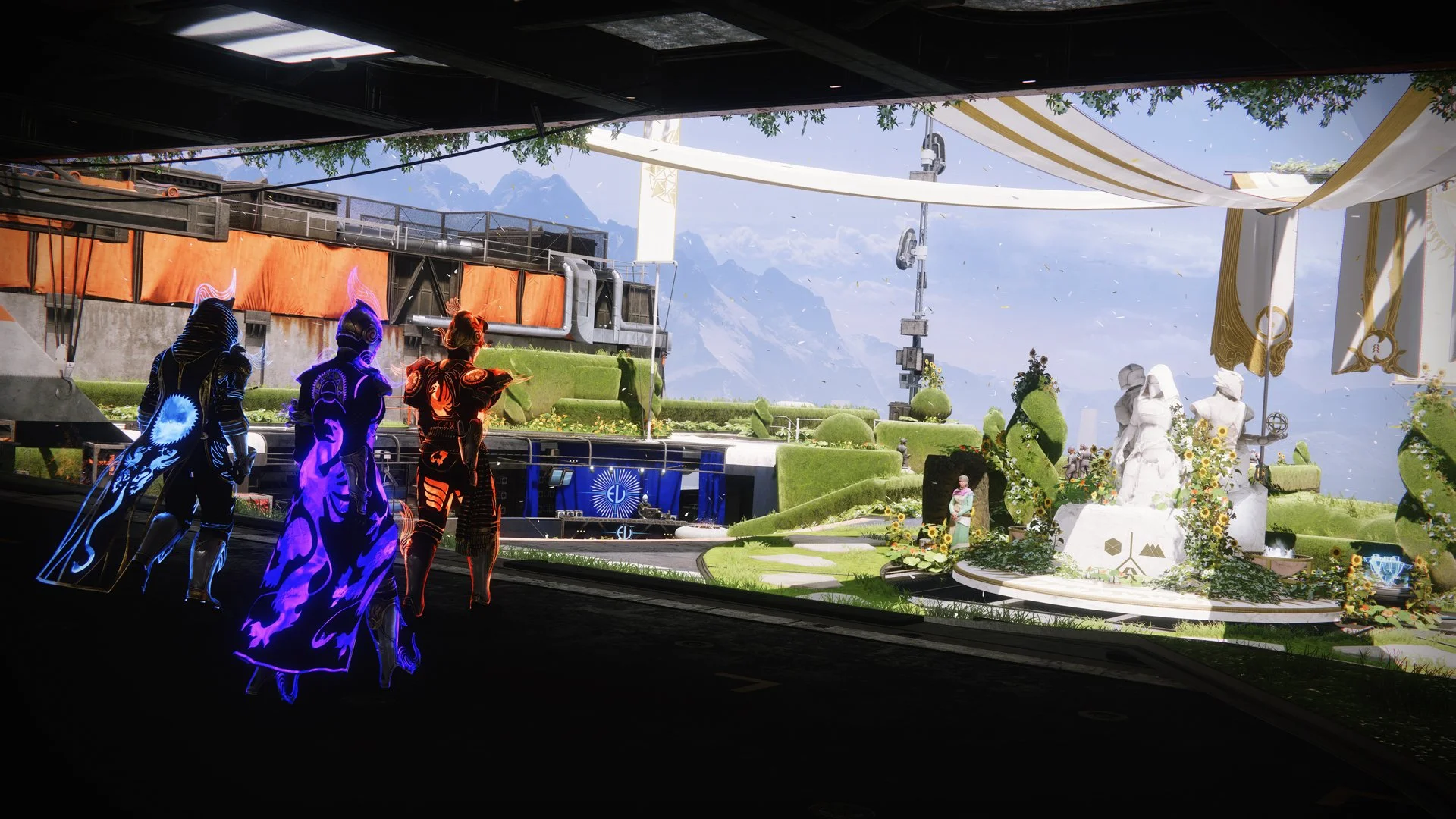
As the first event to receive an event card, Solstice got a ton of systemic updates. The only element of the event that didn’t get reworked was its core: the Solstice armor. The event had always been centered around players going on a quest to earn a powerful set of golden-trimmed armor pieces that could be upgraded to feature a flashy glow. This armor could be kept after the event ended, and served as an enticing and accessible potent power boost for players returning to the game. Our 2022 events team iteration took this quest and its rewards to the next level. We created a new currency, Silver Leaves, which players could earn as an end of activity reward all throughout the rest of Destiny 2’s main ritual activities. We also introduced an all new event activity called Bonfire Bash, in which players would battle waves of enemies to gather fuel to stoke a mystical bonfire at the center of the map as high as they could (more on that later). Players could then burn their Silver Leaves in the bonfire to turn them to a second currency, Silver Ash. Players could then spend this Silver Ash currency, alongside an additional currency earned from Solstice Event Challenges, in the new Solstice Armor Forge system to unlock the five pieces of swanky new solstice armor, improve and reroll their stats, and eventually unlock the glow effect. The Tower social space also got a fresh set of solstice decorations, including lush green grass, white stone carvings, and a permanent golden afternoon time of day. I implemented system that temporarily forced the time of day to the afternoon during the event, and I remember it being surprisingly challenging to find the proper setting in Bungie’s proprietary engine to override the game’s natural day/night cycle and get it to do so in a way that would only override during the event!
Multidisciplinary Designer To The Rescue
Bonfire Bash was my main contribution to Solstice 2022, and I was ecstatic to tear into my second activity design project at Bungie and flex what I’d learned making Strike Devils Lair. This project was the first example of what would go on to become a major theme of my career at Bungie: my knowledge of multiple design disciplines granting me the flexibility to close critical talent gaps on the team. typically at Bungie, designers were very specialized into their disciplines and had little knowledge of design skills outside of those disciplines. I was hired and trained as a Systems Designer, but I had a very unique background due to my history as a contractor at Bungie where I had done activity design work. Event’s team leadership was in a tough spot in early 2022, the Events Team was scheduled to receive a new Activity Designer who was slated to take on the Bonfire Bash feature, but at the last minute they were delayed and could not roll off their original team, leaving us without coverage. Then they remembered ‘hey, Thomas can do that!’ and were able to assign it to me instead of cutting it and making costly rapid pivots and compromises in the overall quality of the Solstice event. Over the course of my career at Bungie my multidisciplinary background would continue to be a major boon in this way. Designers who could flex like this were extremely rare at the company, and I leaned into it as not only did it make me uniquely valuable on many projects, I totally loved it. I greatly enjoyed getting to see and understand more of how the game worked under the hood and relished the self-reliance it gave me as I worked, since I didn’t need to spend as much time on cross-discipline collaboration and alignment. Plus it was just awesome to get to express my creativity in multiple ways. As my career went on and my knowledge of activity design, systems design, and eventually even technical design deepened, I gained an understanding of the way the technical engine tools that drove each type of design interacted with each other that I was able to leverage on features that straddled the gray area between disciplines in a way few other designers could match, and as things began to start going bad for Bungie and the industry and layoffs thinned our headcount, I was often counted on to do the work of multiple designers on a single feature as teams became desperately strapped for resources.
Bring on the Bonfire Bash
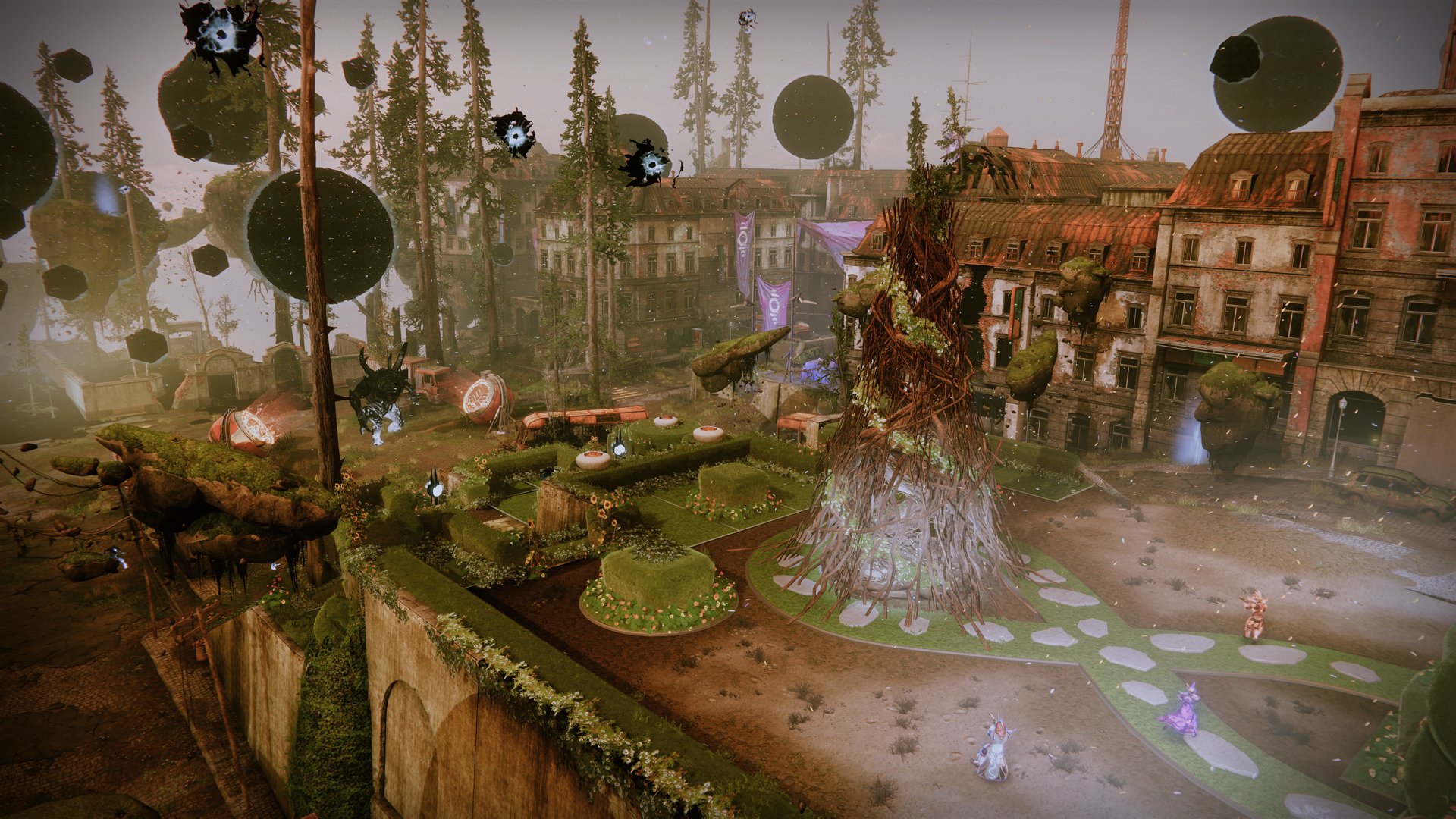
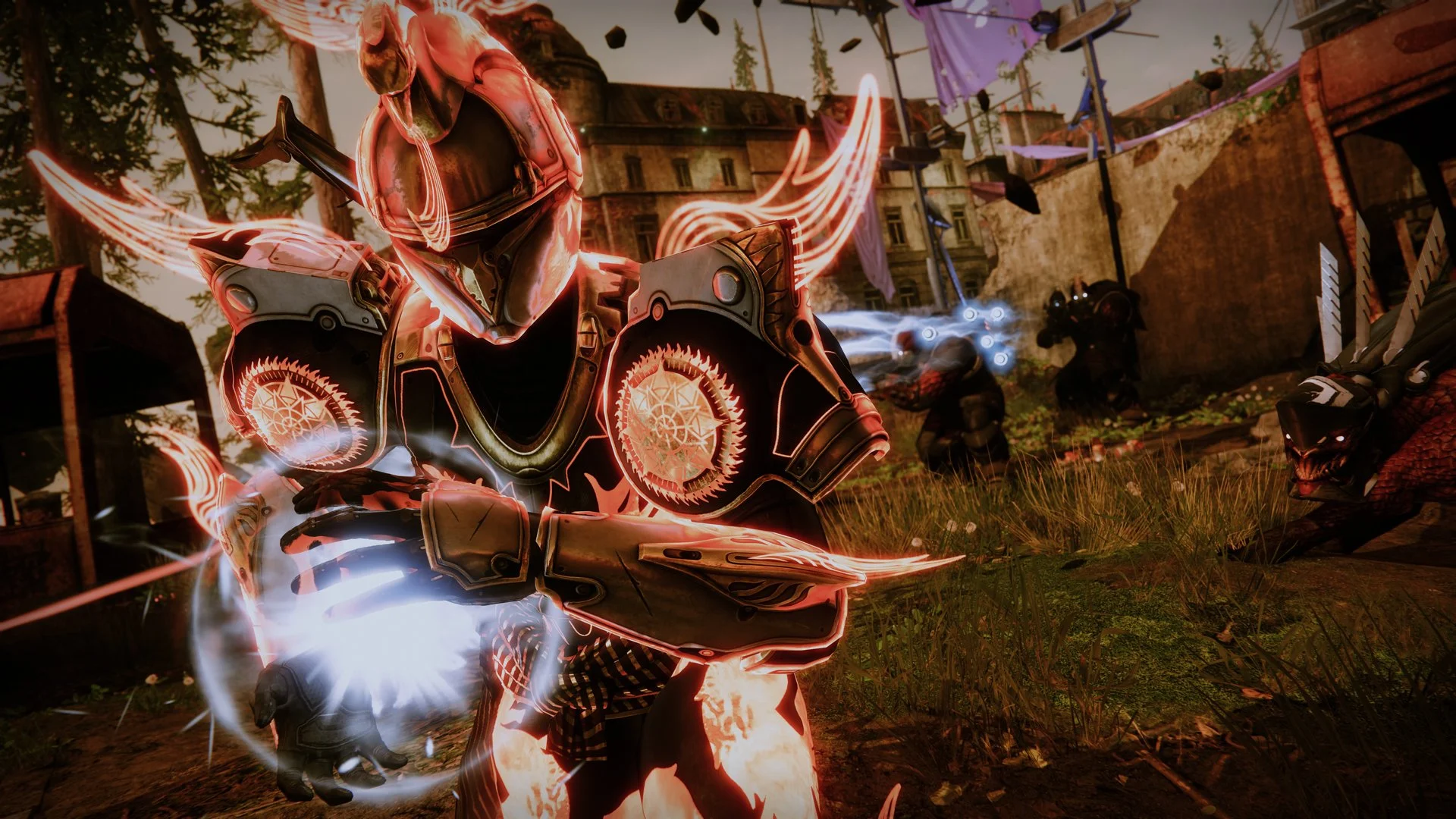
The high level concept and core ideas for Bonfire Bash were handed down to me by the Events Team lead, but I was tasked taking this direction and building it into an actual design for an activity and implementing it. He and I worked closely over the course of the activity’s development to ensure it was meeting goals and fitting into the larger design for the event as a whole. Bonfire Bash was meant to be the central thematic knot in the solstice ritual loop: players would need to return and play a round of bonfire bash regularly to convert the currency they had collected during their regular play in the wider Destiny game world into the currency usable to actually progress through the systemic core of the event and upgrade their Solstice armor. This meant the activity was going to need to be highly repeatable, and also that it needed to be designed with enough pressure that player performance could effect the activity’s outcome. There were also some additional design constraints: It was an event activity, so it needed to be wide funnel, the mechanics could not be too complex or intensive so that it would be accessible to the widest possible swathe of the player base, It was going to be pretty rigidly limited to between 8 and 12 minutes, and lastly the activity was going to take place in the existing ‘European Areal Zone’ space where previous solstice activities had been set, which was a massive floating ruined city block of a semi-futuristic German city. The activity that resulted worked like this: at the center of the map was the Solstice bonfire, a massive ceremonial pyre of white mystical flame. Players’ goal during the activity was to stoke the flames of this bonfire as high as they could before they ran out of time, which would trigger the arrival of the final boss encounter. After spawning in, they had to fight their way to the center of the map, where the bonfire would spawn in, and a timer would start. At this point, waves of enemies would begin to spawn in alleyways and courtyards throughout the map. Players would then proceed to engage these waves in order to slay a ‘Ignitor Carrier’ minibosses, who would drop a carryable sphere of white fire that the players would need to pick up and toss into the bonfire to stoke it higher. An objective off to the side would constantly display the bonfire’s level of stoke to the players to track their progress. once the players reached certain stoke thresholds, a ‘Taken Interruption’ would begin, suspending the spawning of the Ignitors and their backup until players cleared a side encounter of Taken faction enemies that would spawn on the rooftops and floating islands ringing the mainland by destroying three taken blight objects. After each Taken Interruption, the bonfire would grow another section so the flames could be stoked even higher. The activity would continue like this until players either ran out of time, or stoked the bonfire to its maximum level, either of which would trigger the arrival of a massive Taken Ogre boss. Once players defeated this boss encounter, they would return to the bonfire which would fountain out a shower of loot, and consume a portion of their Silver Leaves currency in proportion with how high the bonfire was stoked to be converted to the Silver Ash currency.
They Gave Me The Whole Map, So I’m Going To Use The Whole Map: Accomplishing My Design Goals
I’m pretty proud of the design tricks and the creativity I got to express to design Bonfire Bash to meet the goals for the activity I mentioned above, and working on it is one of my fondest memories from my career at Bungie. I leveraged of the experience with Bungie’s proprietary engine’s activity design tools I had gained in working on Strike Devil’s Lair to great effect during this project, as well as the unique design philosophies I had developed. One of the main ways I attacked the goal of making the activity engaging on repeat play was to build granular variety into the activity at as many levels I could, designing my encounters to have elements that could be swapped around randomly from run to run in order to fight monotony. The majority of the activity was made up of the Ignitor Carrier encounter loop, so I built the activity to randomly select one of three factions at the start, Fallen, Hive, or Cabal, to spawn during those encounters to provide a different experience run over run. I was able to do this very efficiently using the engine tools by building out different factional permutations of the enemy squads players would face, with combatants in differing factions with similar roles grouped together so that the faction could easily be switched while still using the same generic encounter structure. This gave me the freedom to tweak the specific composition of the groups of combatants players would face depending on what faction was spawning so I could account for the power disparities of the different factions’ combatants to keep the difficulty consistent. I really enjoyed this balancing process, asking myself questions like ‘is a Fallen Dreg stronger than a Hive Thrall? if so, should I add less Dregs to the Fallen permutation’s melee squads to keep difficulty consistent?’ Another example of me adding granular variety in this way was the Taken Interruption encounters. I built out a modular Taken Interruption prefabricated encounter structure, which included all the necessary combatant squads, their orders and directives, and destructible objects to make the encounter work, that could be easily duplicated and placed into each area of the map we wanted an interruption encounter. This prefab minimized the setup for these encounters and allowed the activity to ship with over 10 possible Taken Interruption locations, further increasing variety run to run! These prefabs even reused the tricks I mentioned above to make the activity feature different factions to have multiple randomized combatant squad composition permutations so the individual taken interruptions would have even more variety. I had a ton of fun finding every nook and cranny of the map’s rooftops and floating islands where I could put this prefab to work.
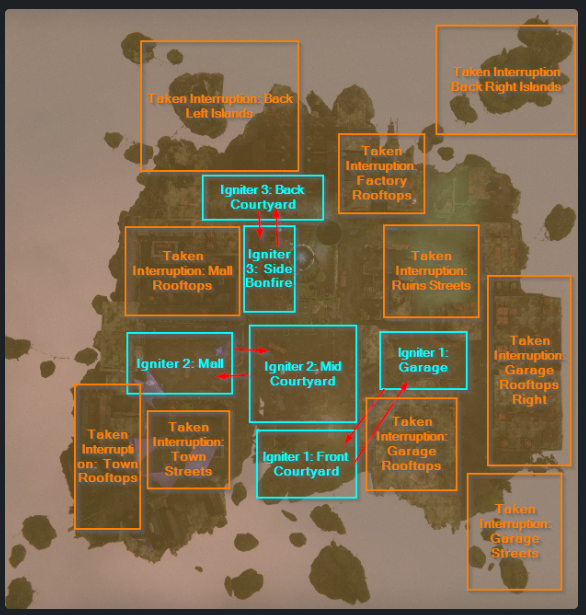
I also had a significant design challenge to grapple with in balancing the activity’s difficulty so that I could realize the goal of having player performance influence the activity’s outcome. Most destiny activities at the time had a very linear structure, with the player progressing from phase to phase to a victory where where what they had previously overcome was guaranteed. This activity was different, it had a time limit, and depending on what players achieved in that time limit, the rewards would scale. I needed to build a difficulty curve into the activity so that achieving a full stoke of the bonfire felt to players like a meaningful expression of their skill. This was a great opportunity to integrate one of my core encounter design philosophies: encounters should be designed around the fantasy, and they should respond to players’ actions in a way that supports the fantasy. I built out a system that allowed the composition of squads to change over the course of the activity to grow more challenging as the activity progressed. Each individual encounter featured groups of combatants of different roles, such as ‘melee,’ 'sniper’, or ‘front line’ and deployed them to points on the map that would make the most sense for those forces to go if their objective was to stop players from defeating the Ignitor Carrier miniboss, creating encounters grounded in the fantasy that felt like a real conflict, not just a game. I created three tiers of difficulty for each role group, which added successively increasing numbers of combatants and more challenging combatant selections. The engine spawning waves would increase the tier and type of groups it was spawning based on how many waves had been destroyed, rather than just being based on the timer, so the activity would adapt its level of difficulty and chaos based on how effectively players were performing. To ensure that a sense of difficulty progression was still maintained through the activity no matter players’ skill levels, hardwired jumps in the combatant group tiers were included with each taken interruption players were able to successfully complete. This coupled with the time pressure resulted in player skill really mattering in how many stokes they could achieve, with the average matchmade group of players usually able to get about 80% of the way there, while coordinated groups of high engagement players could reach max stoke more consistently.
I had a ton of fun working on this activity, and though it was earlier on in my career and would go on to be iterated and improved on in future years, players seemed to enjoy it a great deal too. Some of them even immortalized the debut version of Bonfire Bash in this hilarious and heartwarming Monster Mash parody song. Knowing my work lead to the creation of this silliness is honestly one of the highlights of my career.
Solstice Systems Design
After my glorious stint in activity design in 2022, I continued to work on three additional Solstice iterations in a systems design capacity. Often it was maintenance and upkeep for the event systems to ensure that the event’s reactivation with the year’s updates went smoothly, work like tinkering with the decorations in the tower to make sure they displayed properly, updating event challenge directives to accommodate changes in the wider game like new player verbs for the objectives or new locations where objectives could be accomplished, or updating the rewards for existing systems to include new weapons and armor. And of course there were tons of bug fixes. Working on the Events Team, I was doing work like this pretty much constantly alongside any larger iterations or new features, and often on very tight timelines. There were a few larger systems projects I contributed to that I’m pretty proud of. During the 2023 Iteration of Solstice, I had to update the Silver Leaf economy as quickly as possible. I was feeling pressure from team leadership to get it done with as few changes as possible so the team could proceed to the next event, but I quickly realized that some of the iterations we were making to the Bonfire Bash activity in that year were going to have significant knock on effects to the event economy. Bonfire Bash was being updated to give the central bonfire a higher maximum stoke threshold, making the activity a little more challenging to reach the maximum as players needed to throw in more Ignitor Objects to max it out. However as I mentioned before, Bonfire Bash was where players went to convert their earned Silver Leaves into Silver Ash in order to upgrade their Solstice Armor. The amount of Silver Leaves consumed from their inventory and turned to Silver Ash was balanced on the number of stokes the players could achieve during the activity. Now that that number was higher, this made the activity have a lot more potential reward, which would cause players to proceed through the upgrade track on the armor quicker than we’d intended. After raising this problem to team leadership, they put me in charge of finding the most efficient solution. Rebalancing the Silver Leaf drop rates from the wider game or rebalancing the armor upgrade costs would be too costly of time and worse, would leave us in the same position in future years if Bonfire Bash’s maximum stoke count was updated again. So I found an elegant middle ground by introducing a scalar that could modify the Silver Leaves to Silver Ash ratio, and used it to ensure that though the maximum stoke count was higher, players would still proceed through the upgrade path at the intended rate.
In the 2024 iteration of Solstice, our lead designer on the events team spearheaded the creation of a new Armor Forge system for earning and upgrading the Solstice armor. This system was centered around a new armor forge UI screen accessible in the players quest menu. This screen had 5 categories, each associated with one of the 5 pieces of the Solstice armor (helmet, boots, chest, gloves, class item). In those categories would be bounties, miniature quests with a single simple objective, that the player could complete to earn a currency called [armor piece type] Alloy, and were purchased using Silver Leaves. Once a player had accrued enough Alloy of an armor piece type, they could purchase a quest which would have them enter the Bonfire Bash activity and receive that armor piece as a reward. After earning an armor piece, a player could continue completing the bounties to earn Alloy to purchase a second quest to unlock that armor piece’s glow with an additional completion of Bonfire Bash. The player could also spend silver leaves to reroll the available bounties in a category, refreshing the inventory.
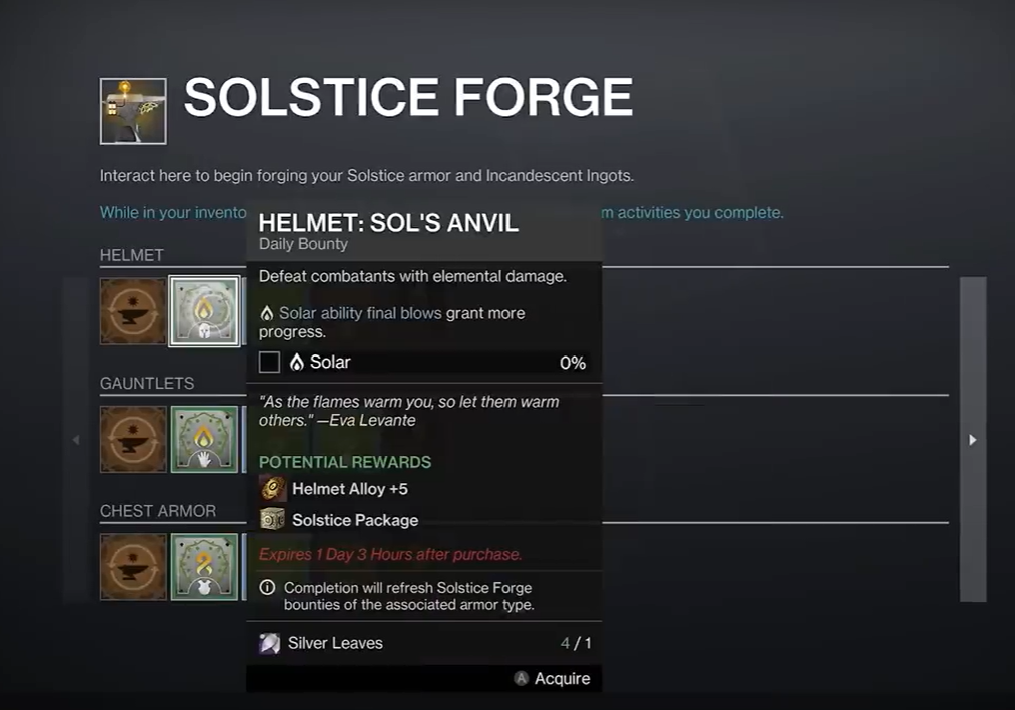
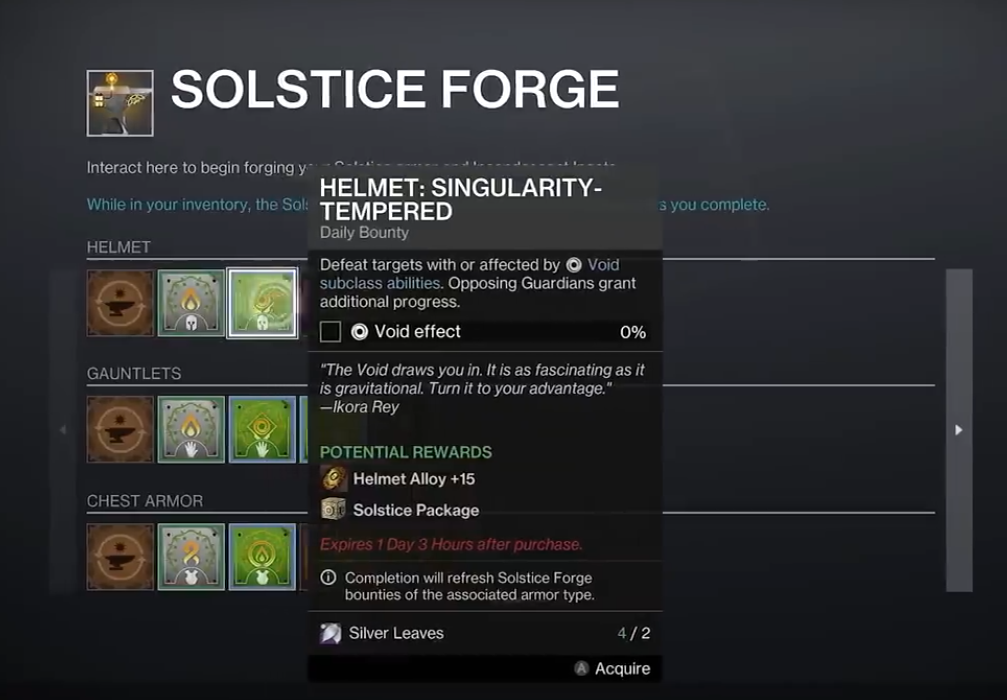
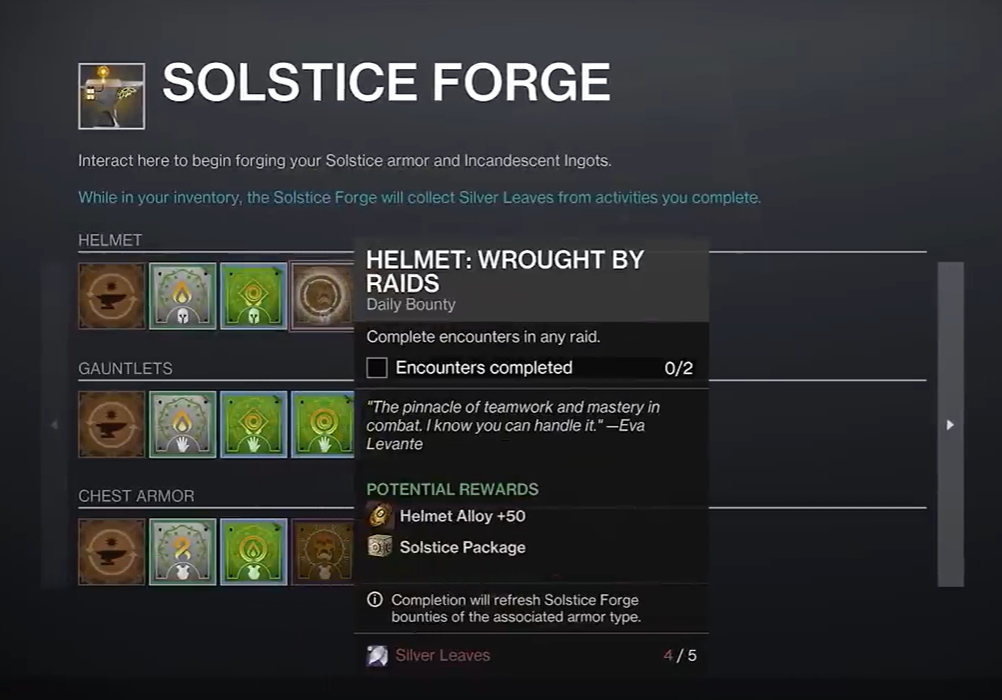
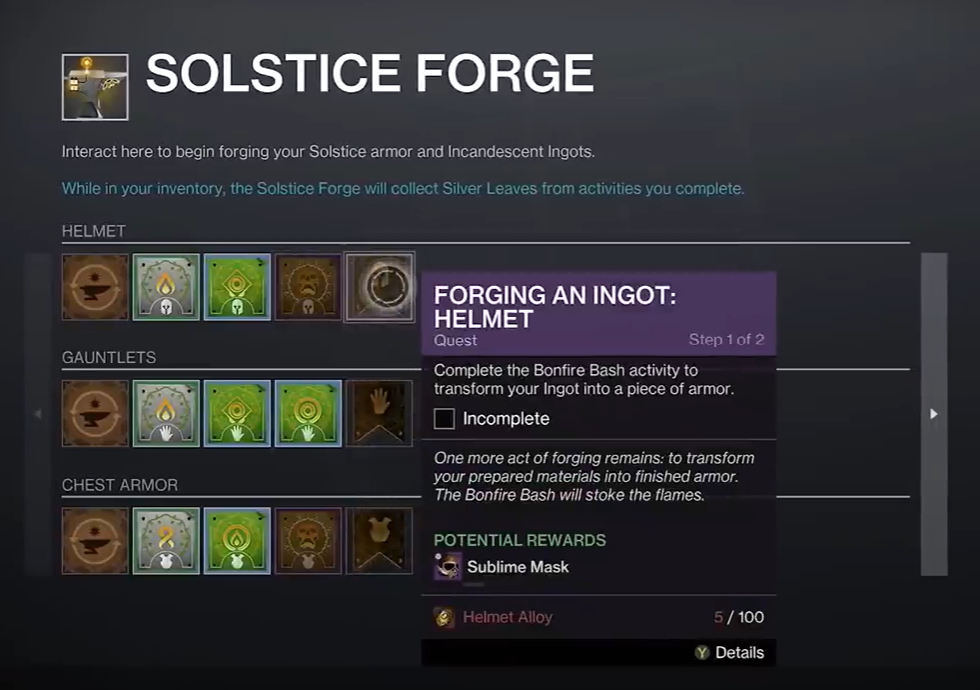
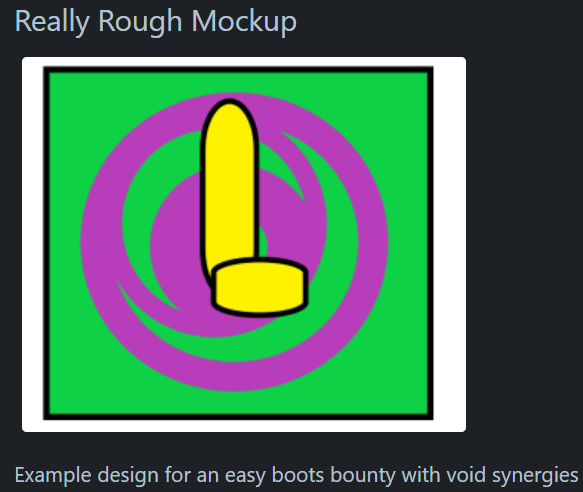
My portion of the system was designing the actual bounties that were to fill each category. The goal with these bounties was to capitalize on the feeling of joy and success created when a player completes multiple bounties at the same time. Bounty style objectives like those in this system were used all over Destiny 2’s game world, and completing them has been tied to countless systems throughout Destiny’s history. A common ritual among destiny players was touring the game’s sources of bounty objectives, filling their quest inventory with bounties carefully selected to have overlapping objectives, so that as many as possible could be completed simultaneously during their normal gameplay. Any destiny player would remember the satisfying feeling of opening their quests page after a play session to see columns of completed bounties, ready to be cashed in. I designed the bounties for the Solstice Forge system to maximize this feeling by deliberately designing overlapping combos into the objectives. The bounties had three rarity levels (green, blue, and purple), each one costing successively more Silver Leaves to buy, having more challenging objectives, awarding more Alloy currency, and being more rare to appear when the category was refreshed. For the first two bounty rarities, which were more common, I organized them around the five elemental damage types in Destiny which player weapons and abilities could possess, creating a few basic objective types with complexity appropriate to each rarity level and then creating a duplicate version for each element. This created an immediate metric by which bounties could be objective stacked, as players could easily go for bounties of the same element, or choose a select few that matched the elements present in their build. Additionally, focusing on elements rather than other factors like weapon type or activity type made sense for the Solstice event since the ultimate goal players were engaging with this system to work towards was elemental themed glows on their Solstice armor. The elements also each had a recognizable symbol which could be used in the bounty icons to allow players to easily tell what the bounties objectives were at a glance. I worked closely with the Destiny icon art team in designing the square icons for the bounties, mocking up a design that included a place to put the differentiating info for each bounty: the background would be colored to match the rarity, a icon shaped like the armor piece type the bounty was associated with would sit towards the bottom, and the element of the bounty’s objective would be placed in the center. I delivered this mock-up to the icons team and they were able to turn my design into a series of beautiful icons. They were very thankful that I had put in the effort to help design a method to communicate all the necessary information so they could focus on banging out the art, because we had over 50 individual icons to make! my design also allowed the icons to essentially have modular elements that could be essentially copy and pasted to create new icons, instead of requiring completely bespoke designs for each bounty, and the icons team was quite thankful for the time savings that brought. The third tier of bounties were much rarer, and focused on players completing challenging or high level content, like Raids, Dungeons, and Nightfall Strikes. The awarded a sizable chunk of currency compared to the previous two tiers to compensate for their rarity and difficulty. They served as a major bonus to players when they got lucky enough to pull one if they had the chops to complete the kind of content asked for.