Free to Play Annual Event
Three week limited time event themed around an Olympics style competition between player classes
Featured a unique ritual loop, special rewards, quests, limited time game modes, and eventually a bespoke activity
Worked with other members of the Events Team to create and implement core event systems, upkeep and maintain the event, and spearheaded the creation of the new activity
Directly contributed to shipping four unique annual versions of the event
Event Overview
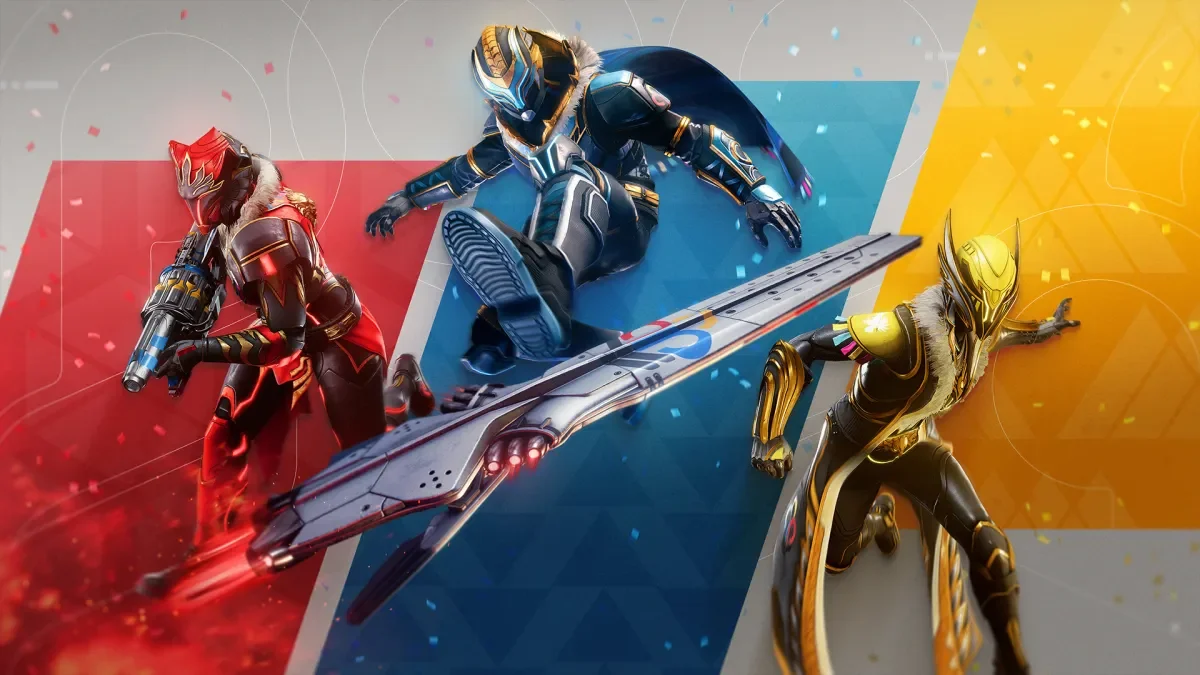
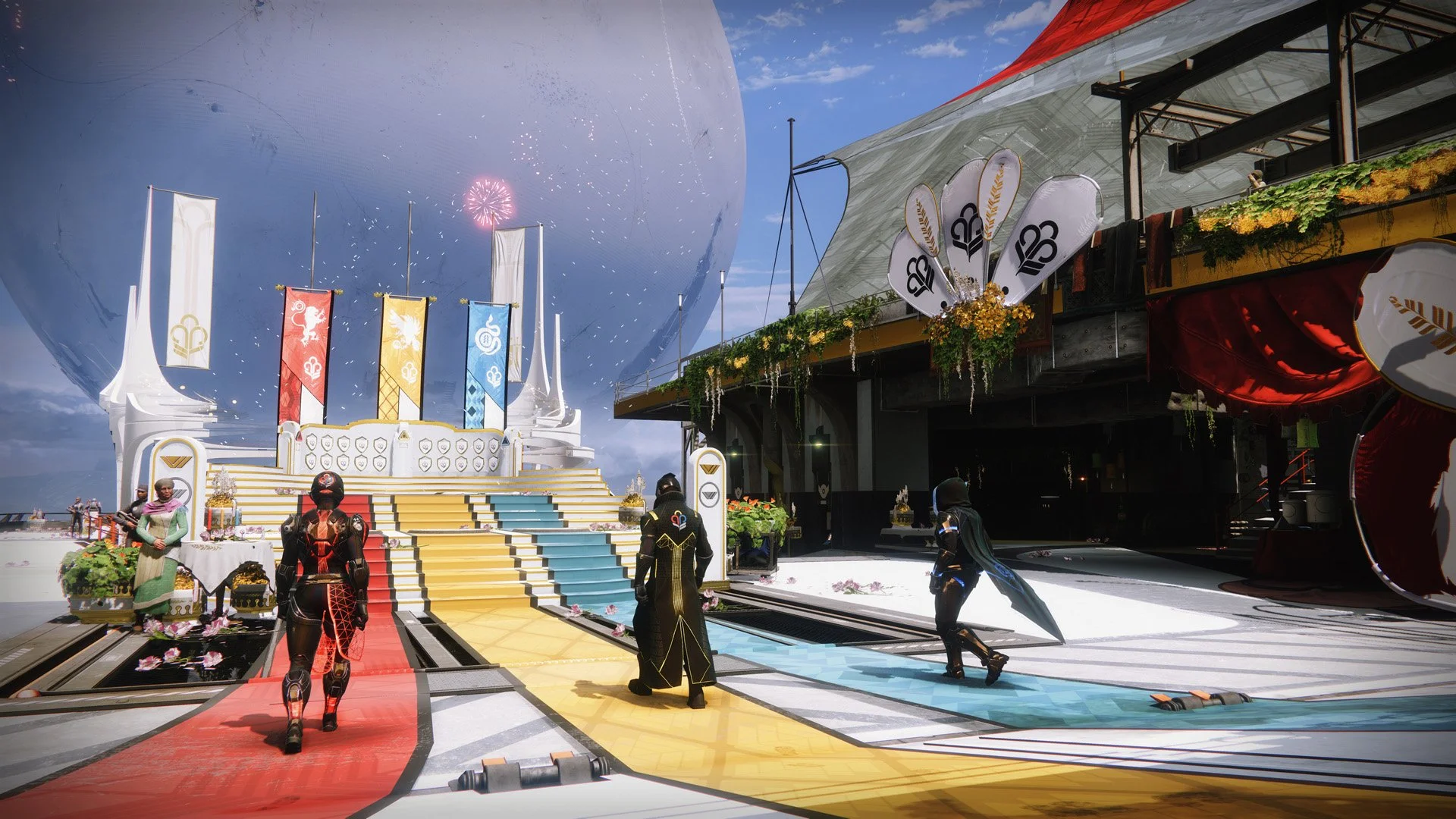
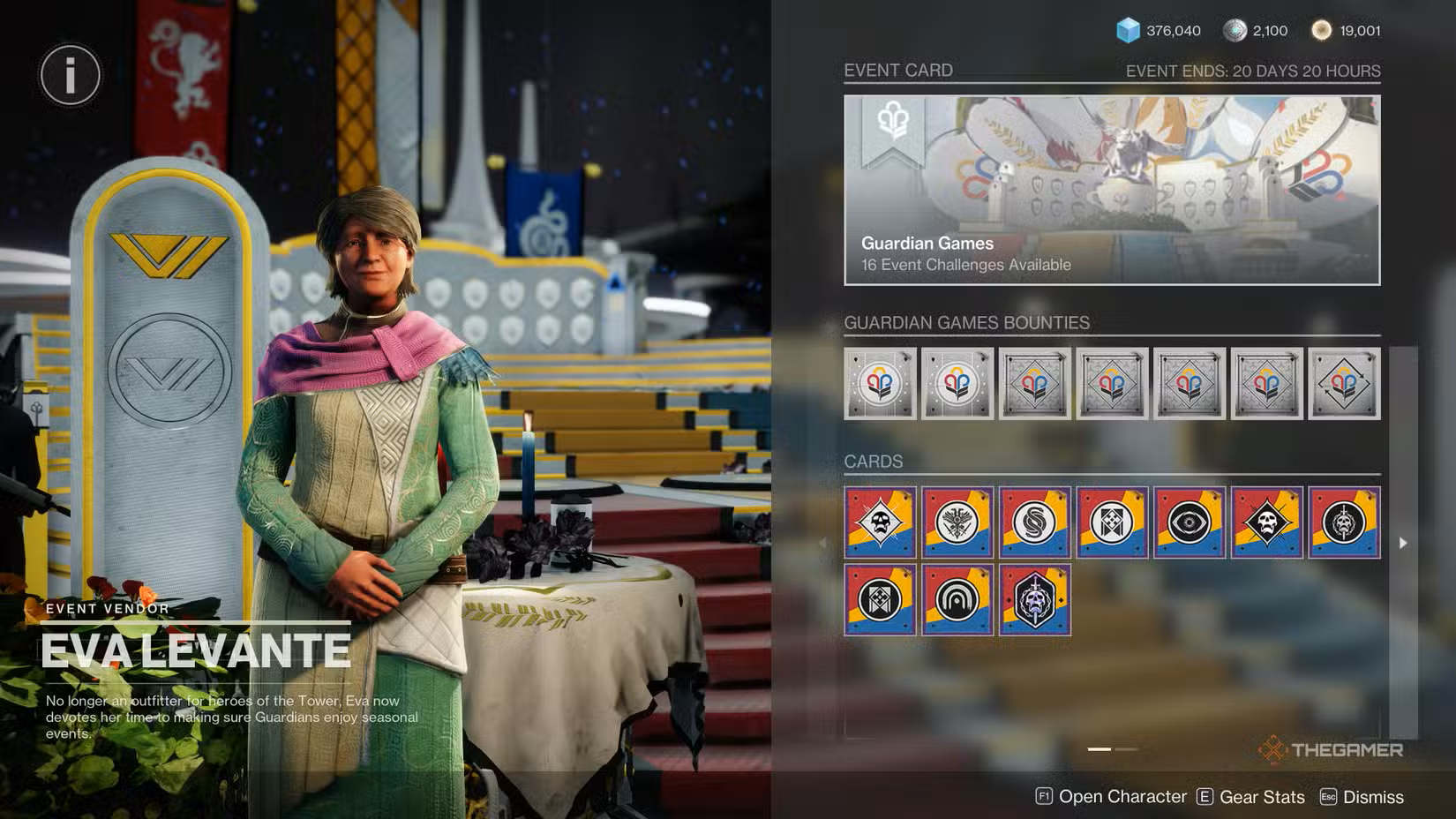
Though the systems and activities of the event evolved greatly over the years I worked on Destiny 2’s events team, the core thematic elements stayed the same. The event featured a competition between destiny’s three player classes - Titan, Warlock, and Hunter - during which players would be able to play activities and complete small quests called contender cards handed out by our event vendor Eva Levante in order to earn ‘Medallions’. These Medallions could then be banked in a central podium in the festively decorated Tower (Destiny’s central social space) to earn event specific loot, and contribute to whatever class you were currently playing’s collective score in the competition. The entire community’s collective Medallion contributions would be aggregated at the end of each week to determine the weekly winner, and then all players could sign in on the weekend to participate in a closing ceremony to earn rewards and decorative glows to display on their character depending on their class’s standing. At the end of the competition, one class would be crowned the victor, and a themed trophy would appear in the Tower commemorating their victory for the rest of the year until the event returned the following spring. Though these core elements stayed the same, we iterated a ton on the event over the 4 years I worked on it.
The Events Team’s Debut
After the formation of Destiny’s Events team in late 2021, Guardian Games was our first event to ship, and we had plans to make some awesome updates. I had a full plate of systems design and technical design work ahead of me to make these plans a reality. The key additions for this new rework of Guardian Games was going to be two new game modes, and a new reward track to go with them. The first was a reintroduction of the Supremacy PVP mode from Destiny 1. The second was a scored Nightfall Strikes mode. To fit the competitive theme, we were going to add a scoring system to our 3 player cooperative PVE Strike missions to allow players to compete for a team high score. Each week, a specific strike would be chosen, turned up to the high ‘nightfall’ level of difficulty, and then enabled for players to compete for the highest score to earn rewards. This special competitive Nightfall mode was where I made the majority of my contributions to this iteration of the event. I set up the activity node structure that allowed players to launch the mission at the correct difficulty, selected the strikes that would be chosen each of the three weeks and set up their rollout schedule, and implemented the new class based matchmaking system made for us by engineering into the activity. The class based matchmaking allowed players to queue for missions with only other members of their class, preserving and enhancing the class vs class theme. One of the elements I designed here that I am most proud of is the amount of choices I gave the player. I believe a social, sandbox heavy game like Destiny is at its most fun when players can engage with it their way, and feel its my responsibility as a designer to provide them those options where I can. I made sure the Guardian Games Nightfall Strikes had variants players could launch that included matchmaking, the new class based matchmaking, or no matchmaking. This way, players could have as social or not social of a mission experience as they desired, and there’d be no obstacles to playing with friends! Adding matchmaking also provided a unique opportunity for players, during that era of the game other Nightfall Strike type activities typically didn’t have matchmaking, forcing players to either attempt them solo or try to form a group outside the game. I figured that since this was for a limited time event meant to be free to all players, I’d give them the best chance at getting to experience higher level Destiny content like this in a group as intended, making this activity accessible to as wide an audience as possible, giving the event some unique character, and potentially giving some players their first experience with high level Destiny content by adding a matchmade option. I also added a normal guardian games strike playlist, so players could run through random strikes together with the new scoring system and buffs enabled to have some casual event themed fun with their friends or matchmade players!
The Medal System
One of my biggest tasks for creating the Guardian Games Nightfall Strikes was implementing the Medal system that allowed players to score. Late in Destiny 1’s developement a medal based scoring system was added to its Strike missions, and a fellow designer and I started by porting that system into Destiny 2. After we had successfully gotten that working, I took over and began expanding the system, designing and implementing new medals to increase the systems bredth and suit our design goals. The core of the system was simple and satisfying. When players achieved something notable or stylish during the gameplay, such as killing enemies quickly, or executing a large enemy, a medal icon would flash at the top of the screen along with a fun little name, and players would see an accompanying burst of points next to their reticule. I built out a bunch more medal types to better cover Destiny 2’s expanded sandbox and to suit our overall goal for the system: to reward players for rapidly switching between weapon and ability kill verbs. I really had a blast thinking of all the ways a player could succeed and feel cool during destiny gameplay and designing and implementing medals to reward them. The medals generally fell into two categories: ‘streaks’ and ‘sprees.’ Streaks involved getting an impressive number of kills with a specific kill verb without dying, while sprees were about getting groups of kills with a certain kill verb quickly. many were deliberately designed to overlap slightly so that players could score multiple medals on a single epic moment of gameplay, creating delicious dopamine rich clippable hit moments. This design space also had some unique challenges. A scoring system like this, while effective to reward players for their skilled moments during a normal run of a mission, also invited players to ‘solve’ it when coupled with the competitive, high score driven nature of the higher level systems design. We knew higher skill level players would learn the system, learn the mission, and then begin asking themselves, ‘what is the most efficient way I can milk score out of the enemies with this set of medals?’ We had no choice but to embrace this and try to find the fun in it, creating a series of situational, difficult to achieve, complex trigger medals for players to attempt to chase and max out. A great example of this was the ‘insult to injury’ medal, based around the fantasy of taunting an enemy before finishing them off. It required players to find a major level enemy, perform an emote in front of them, and then execute them with their finisher ability for a huge hit of points. However, it also limited what we could create as we needed to avoid rewarding behaviors that could become degenerate or exploitative, such as reviving other players. I wanted to create a medal called ‘savior’ that rewarded a player for reviving both of their allies in quick succession, but the risk of players killing themselves over and over to farm it for points was just too great. Enjoy a clip of a destiny player getting an insult to injury medal below!
The Buffs and Rewards
As I mentioned in the previous section, one of our design goals for the Guardian Games Nightfall Strikes was to reward players for switching between weapon and ability keywords. I was tasked with designing and creating a series of fun wild buffs that would be active on players in the playlist that would help reward them further for playing this way, and I had a ton of fun making them. More specific details of how they worked can be seen below, but they were based on the core idea of a player gaining a stacking buff by getting weapon kills that would hasten their ability cooldown, and then gaining a stacking buff for getting ability kills that increased the damage of their weapons. This was intended to help players get into a rhythm of killing with weapons, then swapping to their abilities and back as they managed the stacking buffs to take advantage of when their abilities or weapons were most powerful. It worked great! Players online reported having tons of fun with the buffs the first year they debuted, and they became a part of Guardian Games ever since. The buffs also needed to have three tiers of increasing effectiveness - bronze, silver, and gold - because they were meant to be part of our new reward system for the event, but more on that in the next section. I’m particularly proud of my work on these buffs because they gave me a chance to shine as a multidisciplinary self starter. I didn’t merely paper design these buffs, I implemented them as well, requiring me to pick up technical design and sandbox design skills on the fly. Without me being able to do this, the buffs likely wouldn’t have been built due to the teams usually responsible not having the bandwidth, and the tech design and sandbox design chops I earned figuring out how to implement this content continued to serve me well through the rest of my career at Bungie.
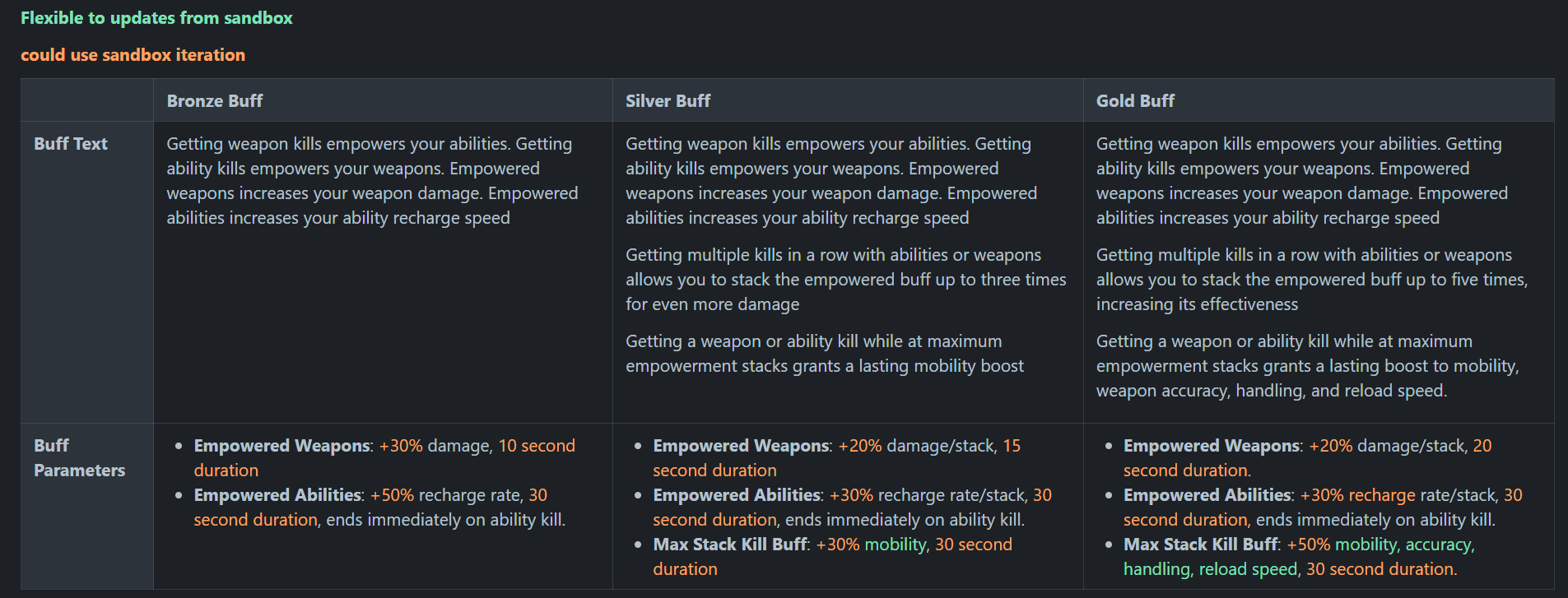
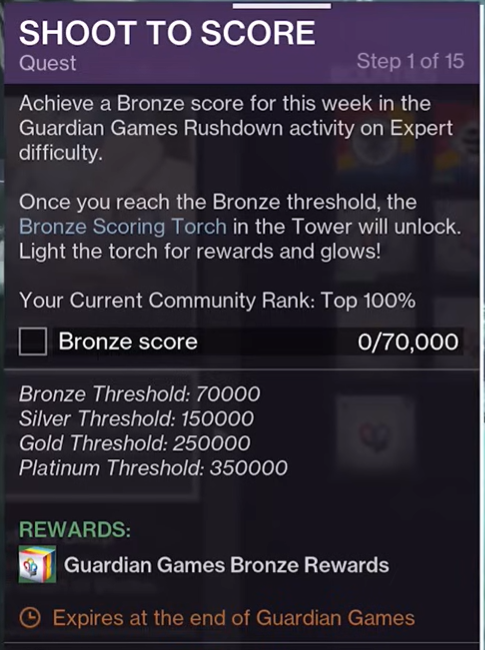
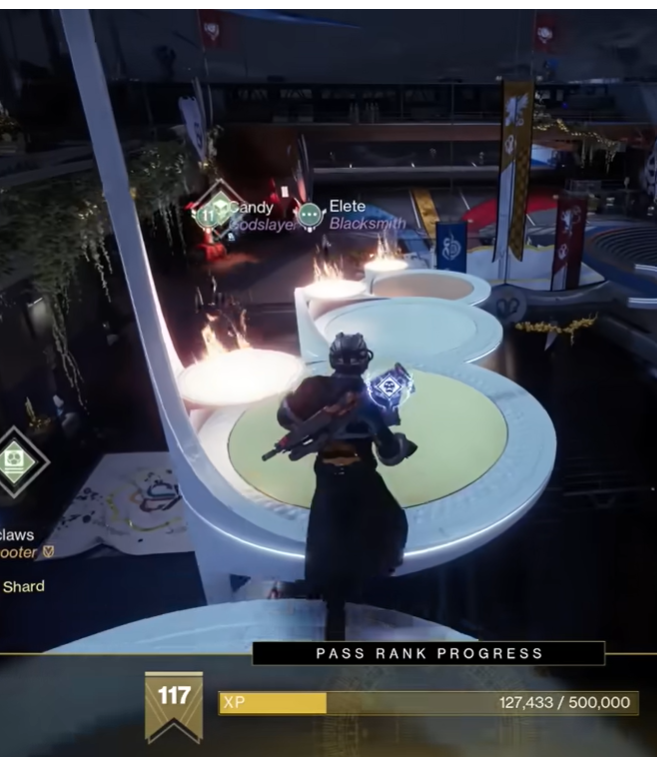
I also contributed a great deal to implementing the new reward system. We added a series of eight event themed floating platforms to the central area of the Tower, each of which contained a ceremonial torch object the player could interact with and receive rewards like a chest. Four of the torches were for the supremacy mode and four were for the Nightfall Strikes. The idea was that once the player hit a highscore threshold in the weekly Strike mission, the floor of the platform (visually themed like a giant medallion!) would fill in, allowing players to jump on, light the torch and get rewards. we had four thresholds: bronze, silver, gold, and platinum. Each gave better rewards than the last, from a few drops of the event themed weapons up to powerful and rare upgrade materials and more valuable versions of the weapons with better perks and more options. Each of the event’s three weeks, players would be able to earn the torch rewards again, and I built a special quest to help them track their score, keep track of the threshold values, and know when it was time to light the torches. Lighting the torches also granted the player the corresponding tier of buff to be permanently active in their runs of the guardian games nightfalls. Additionally, we worked with the VFX department to create some festive glow effects that would activate on players when they met certain scoring conditions so they could flex on one another. A holographic laurel wreath would appear over the players head, colored bronze, silver or gold depending on the players’ class’s standing in the overall competition. A holographic badge would appear over their shoulder colored to match the corresponding score threshold they had achieved in the weekly Nightfall Strike. Lastly, we had the coveted ‘best in Tower’ glow which would bathe your character in a silver spotlight if you had the highest score out of anyone else in the Tower instance in that week’s Nightfall Strike! This design for the event would persist, with annual maintenance, upkeep, and tweaks, until we added the new Rushdown activity three years later
The New Activity - Rushdown
In 2024, Destiny 2 was going through a huge transition, and the events team was a large part of it. Our scope expanded significantly, we got to build all new events, and had even more support for our existing series. As part of this, I was tasked with heading off a big new feature: Rushown, a brand new activity to replace the Nightfall playlist during the 2025 iteration of the Guardian Games event. I was given high level direction of what this activity was meant to be, but designing the specifics of how it worked and how it was going to be built fell to me. It was going to be a boss rush style activity made using boss fight encounters from Destiny 2’s 5 year long history of expansion and season campaign story missions.
I worked on this activity closely with a fellow activity designer, although I quickly fell into a leadership role between the two of us. I owned the activity documentation and concept, repped the activity in playtests with leadership and processed the feedback, was the point of contact for stakeholders from external teams, and took on the most technically challenging and design crucial aspects of the activity’s implementation. Our first step was to go through Destiny 2’s history and pick out boss fight encounters that we thought would work well for this activity. Encounters had to meet certain criteria: 1) They had to be a straight bossfight encounter, one central combatant which players must defeat in order to win 2) they had to be straightforward to complete, with no long side sequences or mechanics that would slow it down or conflict with the boss rush format and 3) they couldn’t rely on complex mechanics bespoke to specific campaigns that were taught to the player in earlier encounters that would not be present in the boss rush. This grand search resulted in a whopping 24 encounters.
Once we had our list, we began porting those encounters from the maps and missions they were from originally into a new master map. This was a meticulous and time consuming process and required close collaboration with the art and lighting teams, but once completed we had a massive rogues gallery of Destiny’s baddest villains all arrayed in one place. I even got to use my knowledge of classic destiny content from my old days on the v500 porting team to bring some encounters from campaigns that had been removed from the game back from the vault as a fun surprise for players! A lot of the encounters required tweaks and updates to work in our boss rush format. In particular, one of the most significant pieces of feedback we got during development was that we needed to remove the dialogue and cinematics from the boss fights to avoid spoiling things from the stories of the campaigns they came from. My fellow activity designer worked on that while I worked on structuring this mass of encounters into an actual boss rush. I began working closely with my team lead to come up with a plan based on what we had, and we decided that we were going to arrange the encounters into five-boss rushes, and since we had 24 encounters and 21 days of Guardian Games, EACH DAY of the event was going to get a unique sequence of 5 encounters. We also determined that each encounter was going to escalate in difficulty, with enemies growing tougher and more aggressive with each successive encounter, and that players would be on a timer. they’d get a little more time added on for completing an encounter, but if the clock ran out before they beat all 5 bosses, their run was over and they’d collect their rewards and have to start over. We’d also give the players limited lives, if they ran out of lives during an encounter and died, they’d have to start the encounter over, wasting precious time.
Creating these activity structures would be my responsibility: stringing the encounters into a rush, creating and implementing the daily rotating rush schedule, adding the timer functionality, and limited lives functionality. Technically this was a challenge, but one that I was suited for perfectly due to my multidiscipline design knowledge I had built up over my career. Probably the biggest design challenge was creating the weekly rush sequence for all 21 days of the event. I had to divide the encounters up into five tiers of difficulty, since the encounters were from all over the game and were very different, and then arrange them into sequences of 5 that were all unique by at least one encounter and tried to avoid having the same encounter in the same position in the rush two days in a row to create variety. It was like solving a sudoku puzzle.
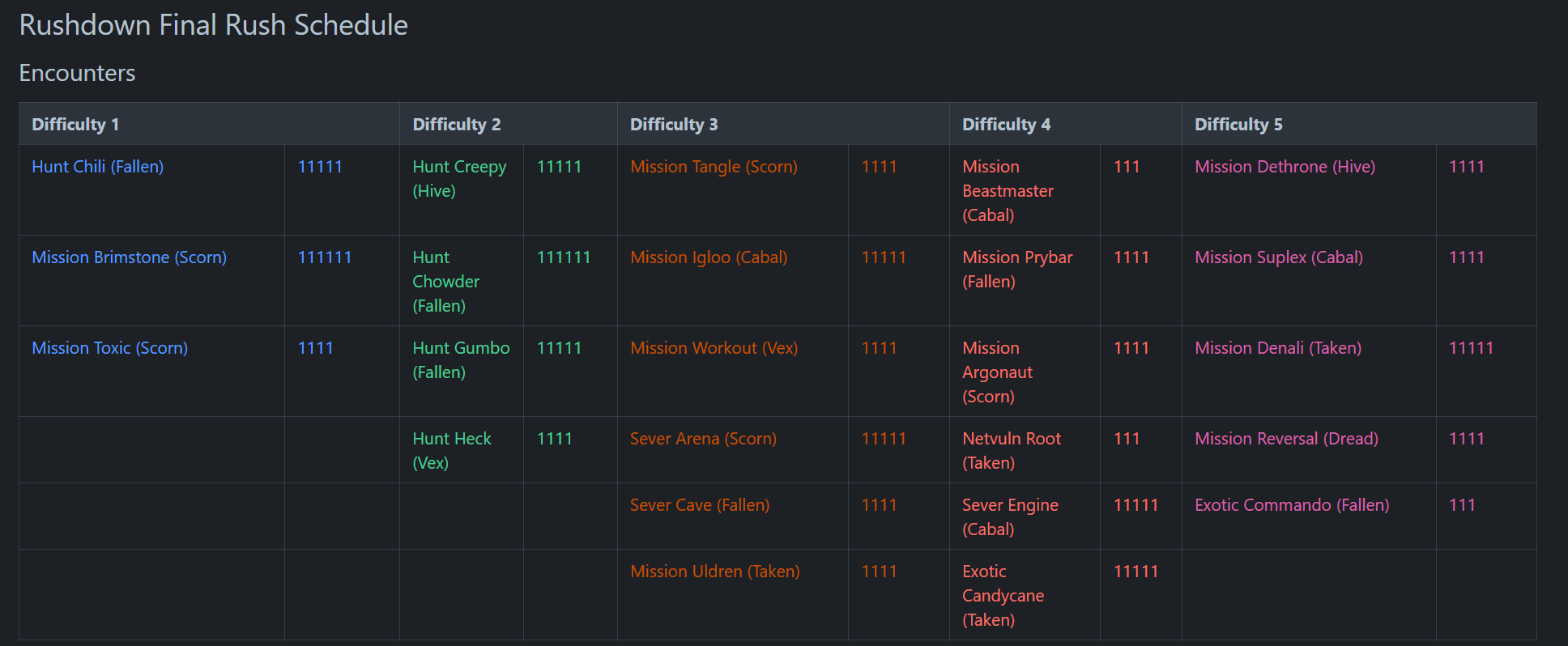
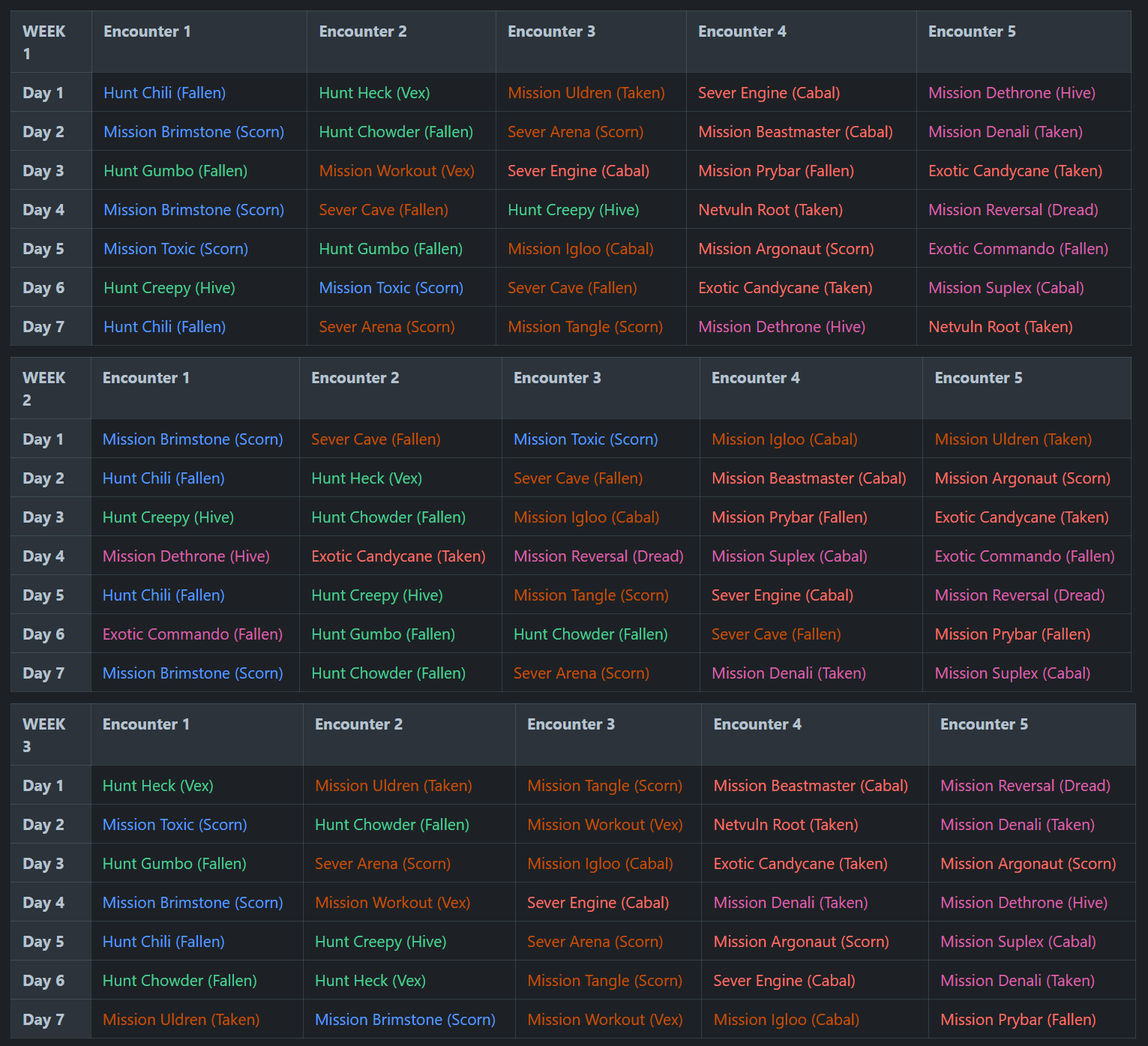
Once I had this plan in place, I had to implement it technically in Destiny 2’s proprietary engine. My unique background as a hybrid activity and investment designer really served the team and I here, as the engine tools I had to interface with to implement this plan required knowledge of both to use. Learning the intricacies of the way player and enemy damage could be dynamically scaled to create the escalating difficulty effect continued to aid me over the rest of my career at Bungie. I also had to learn how to use the at the time brand new phase chain system, which allowed me to string together the encounters my teammate and I ported into the actual rushes I had designed, and then hook them up to a daily rotator so that they would change each day as intended. The following year, I was even able to leverage this knowledge to update Rushdown with a new ‘remix’ mode which gave players a rush of 5 completely random encounters from the selection we ported!
Aztecross’s guide below gives a pretty good overview of how Rushdown worked when it initially launched, although he’s an extremely experienced destiny player so he understates the difficulty and the time pressure a little bit. Average skill level, lower engagement players or players returning after a long hiatus with outdated gear and build strategies found it more challenging than he makes it out to be. Event activities like this were intentionally designed to be accessible and fun for as wide a funnel of players as possible, as the events they were for were intended to be a free incentive for players to return to the game, catch up, and feel rewarded without needing to pay money. Thus they just didn’t target the same level of difficulty, mechanical complexity, or teamwork as in more aspirational Destiny content like raids or dungeons.
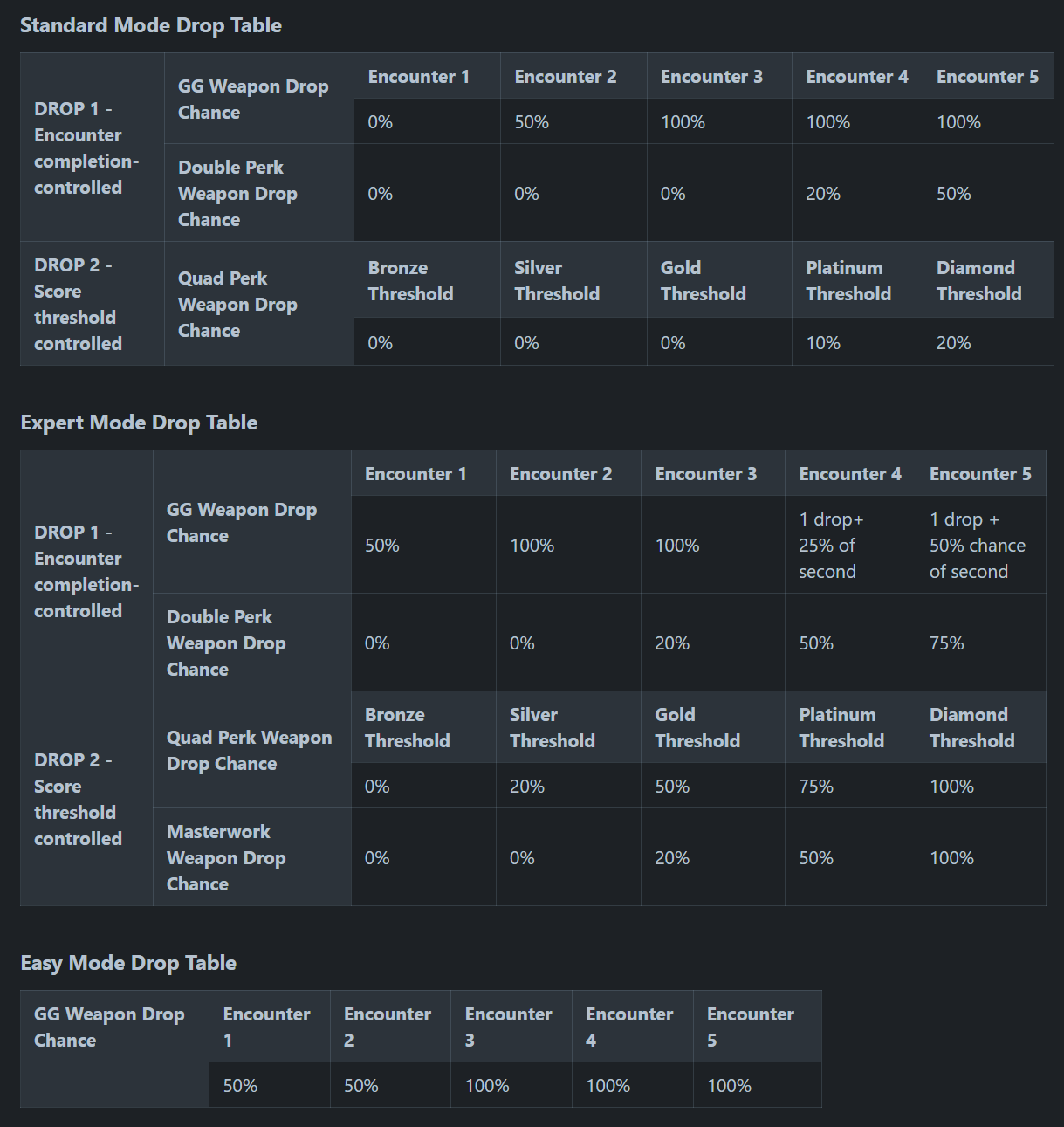
About 75% of the way through Rushdown’s development, the team was hit with a curveball. The Investment designer who was scheduled to roll on to Guardian Games was pulled off to provide emergency support to a higher priority project that was struggling. Fortunately for the team once again, I had both investment and activity design skills, so I was able to leave closing Rushdown in the capable hands of my activity design teammate and step up to handle all of the investment design for Guardian Games 2025. This entailed major upkeep to the event’s core systems, with the chief task being integrating Rushdown into the old Guardian Games Nightfall Strike’s place in the events reward structure. It took a bit of crunch and a little emergency support from a pair of other investment designers who had some downtime since I was essentially doing the work of two designers in half the time, but I was prepared to hustle because I knew I was the only one in a position to see this project though and ship on time. The work I was most proud of during that period was designing the end of activity rewards for Rushdown. Getting to spec out the design for an activity, implement it as an activity designer, and then design and implement the reward structure for that activity as an investment designer was such a unique opportunity that almost no other designers at the company had the skill background to receive. I felt uniquely empowered to see my vision for the activity comprehensively wrought in all aspects of its design, and felt a great sense of responsibility for it. Designing the reward system for Rushdown provided a unique challenge due to the activity’s boss rush nature. Players could achieve varying degrees of success and I had to take those into account in determining what came out of that final chest, this wasn’t going to be a simple one dimensional drop table. As Aztecross breaks down in the video above, I settled on scaling players rewards on two axes of success: how many encounters they completed, and their final score. Below I have a breakdown from my rewards documentation: